
You have an outdated webbrowser. The website might not work correctly.
A Japanese kiritsuke knife is a very striking kitchen knife. The distinctive angled tip is not only visually striking, but also highly practical: the relatively straight edge helps with long, clean cutting motions, while the tip is useful for precise work. You mainly use kiritsuke knives for vegetables, fish, boneless meat and fine cutting tasks where you want to maintain control. If you choose a kiritsuke, you're choosing a practical eye-catcher for your kitchen.
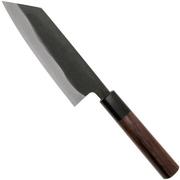


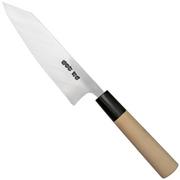


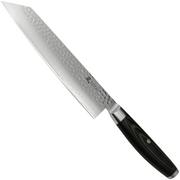


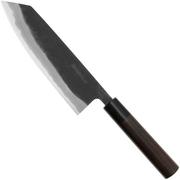


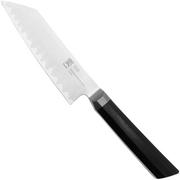

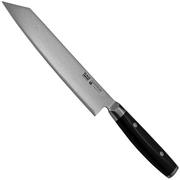




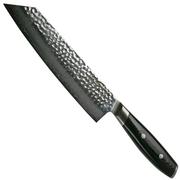


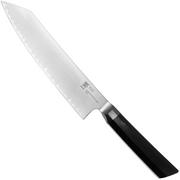

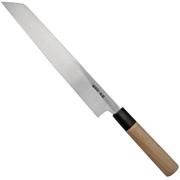

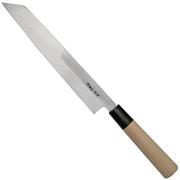

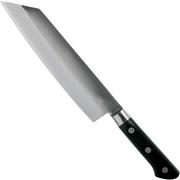

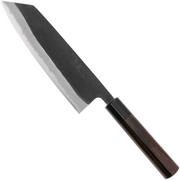

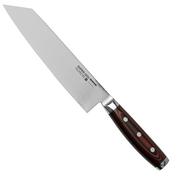


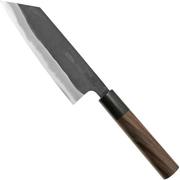
A kiritsuke is a distinctive Japanese kitchen knife with a long, fairly straight edge and a characteristic angled tip. That shape is precisely what makes the knife interesting. The straight cutting edge helps with long, clean cutting motions, for example when cutting vegetables, fish or boneless meat. In addition, the tip gives you extra control for delicate work, such as scoring, trimming or positioning your ingredients precisely. As a result, a kiritsuke feels precise and intentional in hand.
The kiritsuke, as you often see it these days, is a relatively modern style of Japanese kitchen knife. This shape is derived from the straight edge that you also see on the santoku and nakiri, but combined with an angled tip (kengata tip) that is reminiscent of a yanagiba, for example.
Traditional kiritsukes were often single-bevel and therefore mainly intended for experienced users. Many modern kiritsukes feature a double-bevel edge, making them more accessible to use. This can sometimes be a little confusing, because a kiritsuke nowadays overlaps quite a lot with other Japanese kitchen knives, especially the bunka. Simply put, you can see it as a santoku with a kengata tip.
Still, using a kiritsuke knife is fairly logical. The relatively straight edge is useful for cutting vegetables with precision, as it maintains good contact with the cutting board. The sharp tip is particularly handy for finer work, such as scoring, trimming or determining exactly where your cut begins.
A kiritsuke is very close in style to a santoku. A santoku is a compact, versatile kitchen knife with a fairly straight edge and a rounded tip. A bunka looks very similar, but instead of that rounded tip it has a sharp kengata tip. A kiritsuke is originally a single-bevel bunka.
Nowadays, however, many kiritsukes are double-bevel. As a result, they are more accessible to use, but the distinction from other Japanese knives becomes much less clear.


